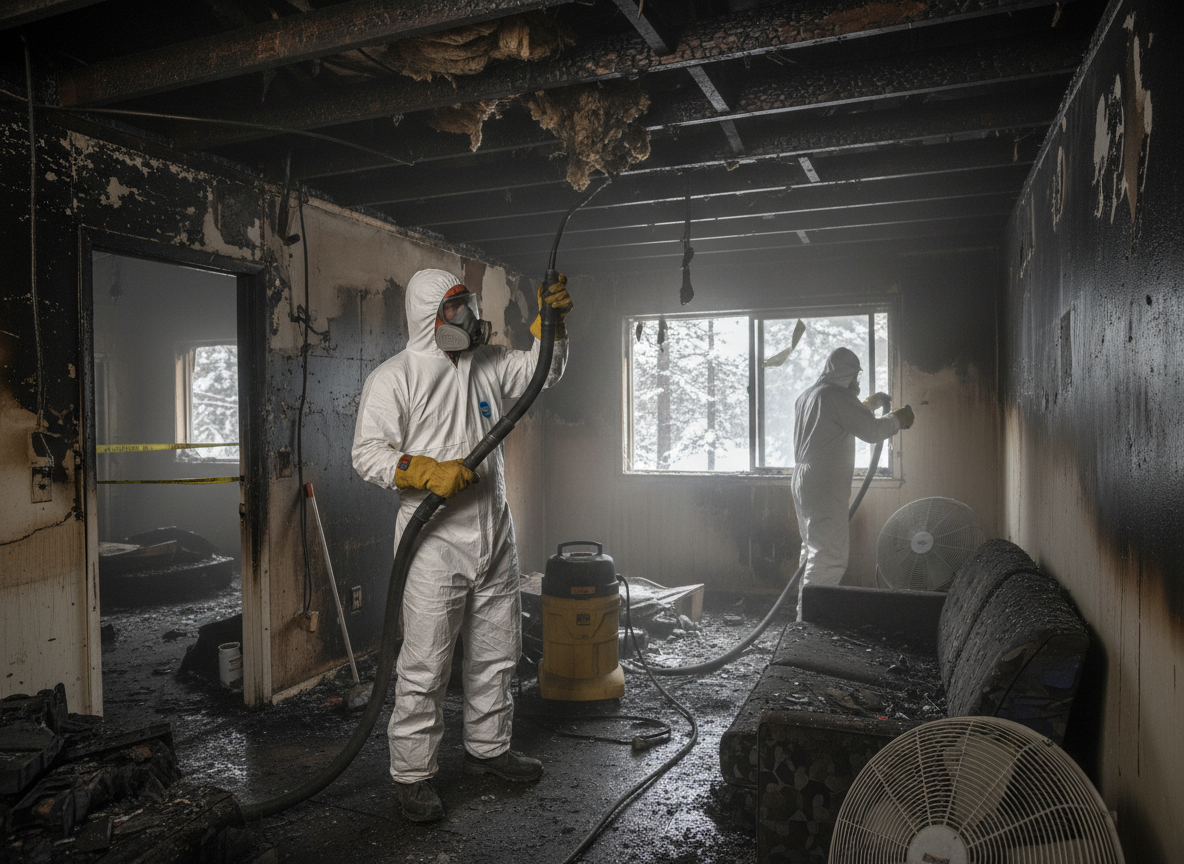
Apartment fires in Rimforest often involve older multi-unit buildings where smoke travels through shared vents, attics, and wall cavities common in San Bernardino County mountain construction. Winter snowfall adds layers of complication because accumulated snow can hold soot against siding and foundations until meltwater carries residues into crawl spaces. Technicians must first stabilize the scene by removing snow loads before interior extraction begins, then address porous materials like drywall and insulation that absorb odors quickly in the cold, dry air at elevation. Failure to account for these conditions leaves lingering smells that reappear when spring temperatures rise.
Cleanup protocols prioritize negative air machines and HEPA filtration to contain particles before they spread to unaffected units, especially important when Lake Arrowhead winds push smoke across neighborhoods. Crews test surfaces with specialized meters to determine which cabinetry, flooring, and fixtures can be salvaged versus those requiring disposal. In units built before updated fire codes, hidden voids behind stairwells frequently trap residues that standard vacuuming misses, requiring targeted disassembly. All work follows local permitting guidelines for waste handling in the San Bernardino County area.
Drying equipment must be calibrated for Rimforest’s temperature swings, where daytime melt and nighttime freezing cycles can re-wet surfaces mid-process. Odor removal uses thermal fogging and hydroxyl generators suited to enclosed apartment layouts rather than open homes, preventing chemical residues from affecting neighboring tenants. Final clearance includes third-party air sampling to confirm safe re-occupancy before residents return.
Technician insight
In Rimforest, the thing that catches most people out with Apartment fire cleanup is how heavy winter snowpack sits against building foundations and later melts into soot-laden water that soaks subflooring and insulation in older mountain apartments near Pine Ave.
Smoke Migration Through Shared Vents
A kitchen fire in a Rimforest apartment spread smoke into two neighboring units via common ductwork during a heavy snowfall week. We removed snow from exterior walls first, then extracted soot from wall cavities and ran hydroxyl treatment through the shared HVAC. Tenants returned after clearance testing showed safe air quality levels.
How it works
- 1
Initial Assessment and Containment
Technicians arrive within hours, secure the unit, and set up barriers to prevent smoke migration into adjacent apartments.
- 2
Soot and Debris Removal
Loose soot is extracted from all surfaces using HEPA vacuums and sponges before deeper cleaning begins.
- 3
Odor Neutralization
Thermal fogging and air scrubbers treat porous materials and HVAC systems to eliminate embedded smoke odors.
- 4
Drying and Final Clearance
Moisture meters guide drying, followed by air quality testing before the unit is released for re-occupancy.
Pricing
Cost depends on square footage affected, smoke penetration depth, and whether winter access or snow removal adds time.