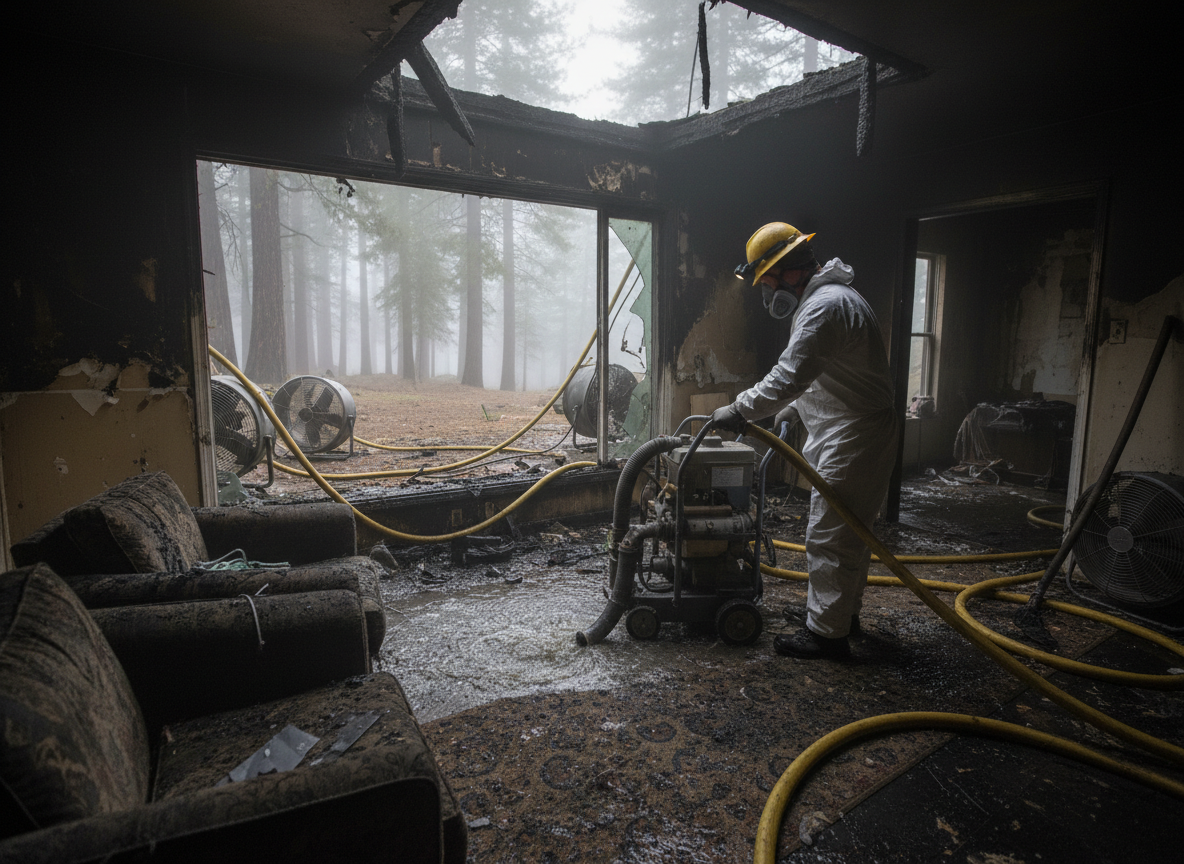
Rimforest cabins built on steep San Bernardino County slopes often feature older wood framing and limited crawlspaces that trap water from fire hoses or spring snowmelt. When suppression water meets residual soot, it creates acidic residues that corrode metal fasteners and wiring faster than in drier climates. Technicians must map every joist intersection because hidden saturation along the uphill side of foundations spreads laterally under floorboards before it is visible.
Lake Arrowhead weather patterns bring rapid freeze-thaw cycles that expand ice inside charred wall cavities, loosening already compromised drywall anchors. Standard dehumidification protocols fail here unless equipment is staged to account for cold air pooling in lower levels during winter. Restoration crews therefore install temporary heated enclosures and monitor moisture at multiple depths rather than relying on surface readings alone.
Local building practices in Rimforest frequently include unpermitted additions that lack proper fire stops, allowing smoke and water to travel between units during combined incidents. Restoration work must satisfy current San Bernardino County seismic and wildfire defensible-space requirements when replacing damaged sheathing. Crews document every penetration and reroute utilities to maintain clearance from rebuilt slopes that may shift after saturation.
Technician insight
In Rimforest, the thing that catches most people out with Fire and flood restoration is how winter snowfall on steep lots funnels extra water into already charred sill plates of older cabins near Lake Arrowhead, turning a visible fire job into hidden rot along the downhill foundation within weeks.
Rimforest Cabin After Winter Fire
Heavy snowmelt entered a fire-damaged Rimforest home through compromised roof sheathing on a sloped lot. Inspection revealed saturated rim joists and mold starting behind baseboards. We extracted water, installed heated drying chambers, and replaced affected framing while meeting county defensible-space rules. The home passed final inspection with no recurring moisture issues.
How it works
- 1
Initial Site Assessment
Inspect all affected levels for hidden water paths created by sloped lots and record soot depth plus moisture content in framing.
- 2
Water Extraction and Containment
Remove standing water from fire suppression and snowmelt while isolating HVAC to prevent soot redistribution throughout the structure.
- 3
Drying and Monitoring
Deploy cold-weather drying equipment and track readings at multiple elevations until wood moisture returns to regional norms.
- 4
Cleaning and Odor Neutralization
Apply pH-adjusted cleaners to neutralize acidic residues and seal remaining surfaces before reconstruction.
- 5
Final Verification
Confirm dryness, air quality, and code compliance before returning the property to the homeowner.
Pricing
Upfront quotes provided after on-site inspection because damage extent varies with terrain and seasonal water load.