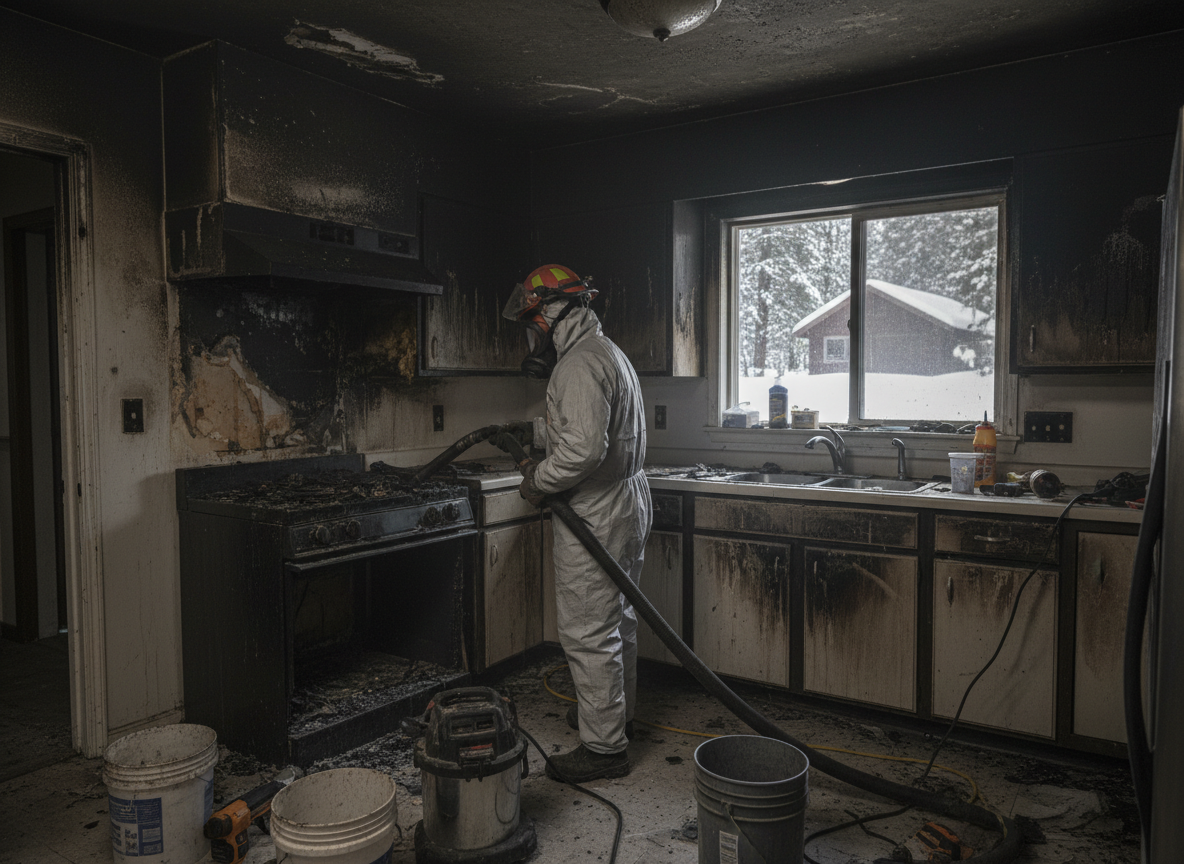
Rimforest sits at elevation in the San Bernardino National Forest with heavy winter snow loads that often melt and mix with soot after a structure fire. Crews must first stabilize roofs and attics before water intrusion turns residual ash into caustic slurry that migrates through cedar siding and older plank floors common in 1960s-1980s cabins near Pine Avenue. Delaying extraction lets acids etch copper wiring and HVAC coils, raising replacement costs in homes already stressed by freeze-thaw cycles.
Smoke from forest fires travels horizontally through Rimforest’s dense tree canopy and settles in crawl spaces and under decks where Lake Arrowhead winds push it. Porous materials like redwood paneling and mineral wool insulation hold odors longer than in drier inland valleys, requiring targeted ozone or hydroxyl treatment rather than simple ventilation. Technicians test for pH levels on concrete slabs because alkaline ash combined with snowmelt can corrode rebar in older foundations along the Rimforest divide.
Electrical and plumbing penetrations in hillside homes frequently act as chimneys during fires, carrying soot into wall cavities that standard visual inspection misses. Restoration teams open select sections of drywall only after negative-air machines isolate the structure from neighboring properties on narrow Rimforest streets. Post-cleaning, crews verify clearance with swab sampling because residual hydrocarbons re-volatilize once spring temperatures rise and snowpack recedes.
Technician insight
In Rimforest the thing that catches most people out with fire damage restoration near me is melted snow dripping through charred roof decks weeks after the fire. Older homes along Pine Ave have layered asphalt shingles that trap soot; once water hits it the pH drops and eats at electrical boxes hidden in the attic. We always pull insulation and run negative air before the next storm hits or the job doubles.
Attic Soot Migration After Winter Melt
A Rimforest cabin near Lake Arrowhead lost its roof in a wind-driven fire. We found heavy soot in the attic that had wicked into mineral wool when snow melted through the ridge vent. After removing insulation and treating the rafters with alkaline neutralizer we sealed the space and ran air scrubbers until clearance tests passed.
How it works
- 1
Emergency Board-Up and Site Secure
Tarps and temporary barriers protect exposed framing from Rimforest snowfall while crews document the loss for insurance.
- 2
Soot and Ash Removal
HEPA vacuums and specialized sponges clear surfaces before snowmelt can reactivate acidic residues in crawl spaces.
- 3
Odor Neutralization
Equipment runs in sealed rooms to treat smoke trapped in cedar and insulation typical of local mountain homes.
- 4
Rebuild and Final Clearance
Repairs match original materials and pass third-party air-quality checks before homeowners return.
Pricing
Upfront quotes after on-site inspection; final cost depends on smoke migration depth and winter access delays.